Gases - ENS16x TVOC/eCO2
ENS16x TVOC/eCO2 sensors
Plugin details
Type: Gases
Name: ENS16x TVOC/eCO2
Status ESP32: COLLECTION G CLIMATE
Status ESP8266: COLLECTION G CLIMATE
GitHub: P164_gases_ens160.ino
Maintainer: flashmark
Used libraries: I2C
Description
Sciosense ENS160 and its successor ENS161 are multi-gas sensors based on metal oxide (MOX) technology. They can detect multiple VOCs including ethanol, toluene, hydrogen and oxidizing gases. The sensors are connected to the I2C bus and provide preprocessed data as TVOC and eCO2 values. See https://www.sciosense.com/ens16x-digital-metal-oxide-multi-gas-sensor-family/ for details about the device.
Hardware
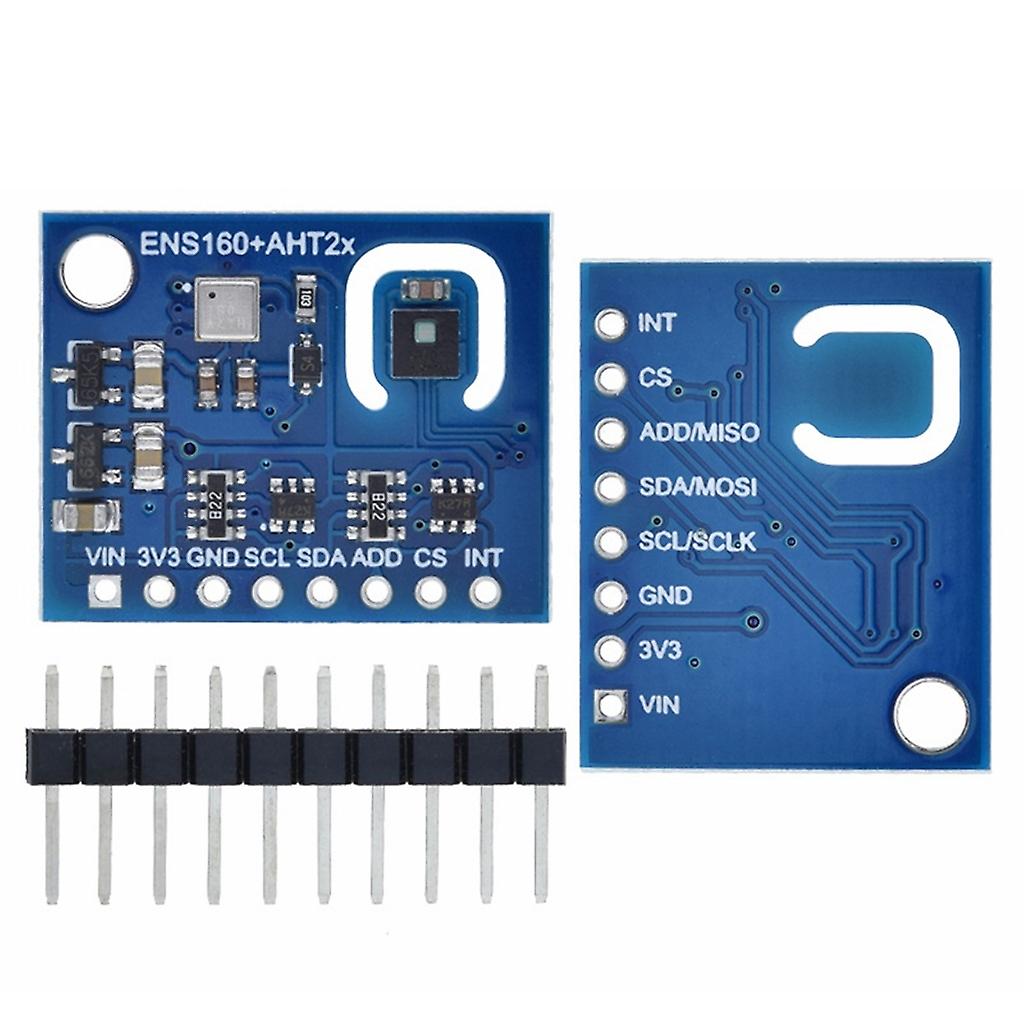
Various boards with the ENS160 are available through electronics market places like Aliexpress. A popular board contains both ENS160 and AHT21 on a single PCB. The AHT21 can be used for temperature compensation as provided by this plugin.
Configuration
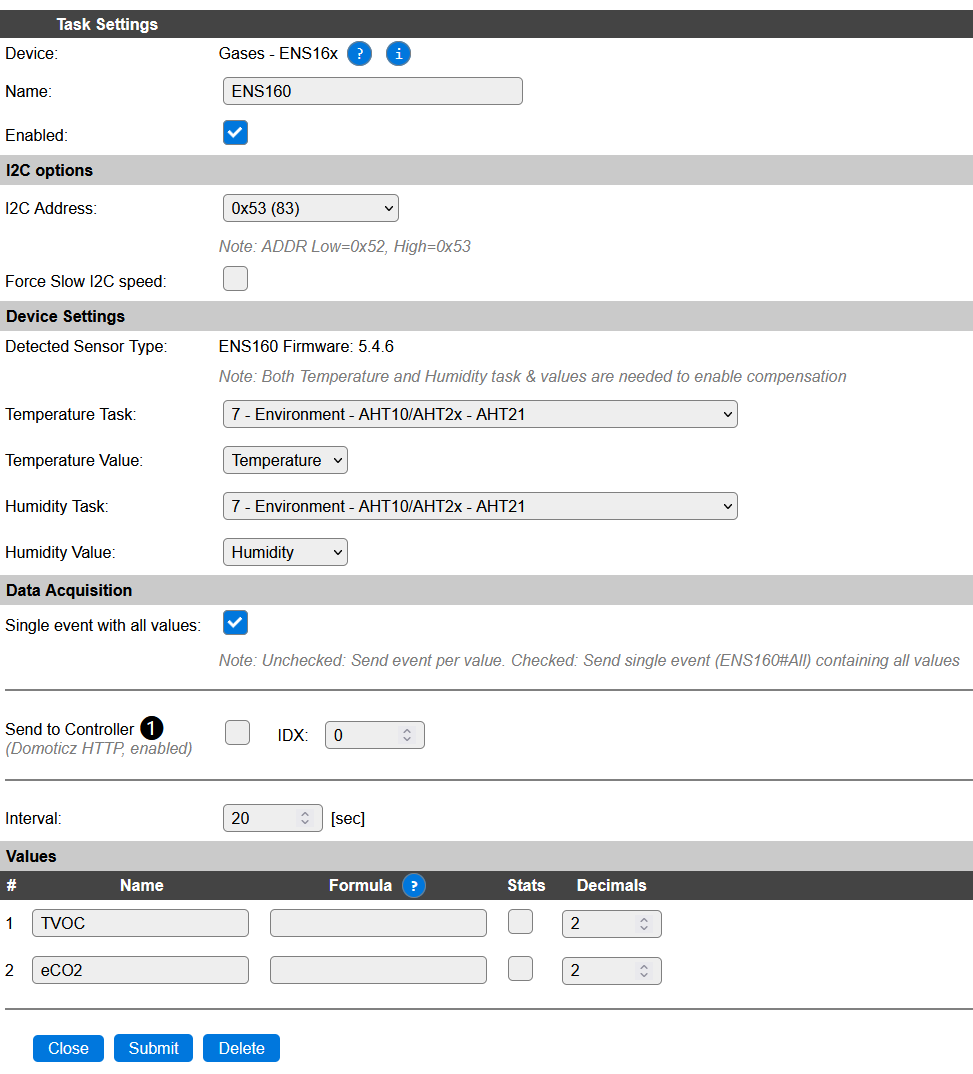
Name: Required by ESPEasy, must be unique among the list of available devices/tasks.
Enabled: The device can be disabled or enabled. When not enabled the device should not use any resources.
I2C options
I2C Address: The sensor supports two addresses. The actual address depends on the voltage on the ADDR pin of the device.
Address |
Remark |
|---|---|
0x52 |
Connect ADDR GND |
0x53 |
Connect ADDR to VDD (default on most boards) |
The available I2C settings here depend on the build used. At least the Force Slow I2C speed option is available, but selections for the I2C Multiplexer can also be shown. For details see the I2C Bus page
The chip supports both SPI and I2C. The plugin only support I2C using the following pins:
1 SDA: Data [MOSI/SDA]
2 SCL: Serial Clock [SCLK/SCL]
3 ADDR: Address [MISO/ADDR]
6 INTn: Interrupt [INTn]
7 CSn: SPI interface select, low-> SPI, high->I2C [CSn]
For this plugin the CSn must be wired to VDD to enable the I2C protocol.
On boards sold online, SDO and SDI are often already pulled-up, setting the default I2C address to 0x53.
Device Settings
Detected Sensor Type: Shows either
ENS160orENS161or a number if no sensor or an unknown sensor ID is detected. It will also show the firmware version read from the device if the data is available.Temperature Task: Task (plugin) providing the temperature compensation
Temperature Value: Value for the temperature compensation
Humidity Task: Task (plugin) providing the humidity compensation
Humidity Value: Value for the humidity compensation
The ENS16x provides temperature and humidity compensation. The plugin must provide the actual temperature and humidity to the device to enable this compensation. For this the plugin needs to read these values from other tasks.
Using the Temperature Task and Temperature Value the task and value for the Temperature compensation can be selected. Compensation can be switched off by selecting Not Set.
Using the Humidity Task and Humidity Value the task and value for the Humidity compensation can be selected. Compensation can be switched off by selecting Not Set.
Note that if either one of the tasks is set to Not Set compensation is switched off and a default value is used.
The ENS160 is sold on popular websites on a board including the AHT21 temperature and humidity sensor. This sensor can be used for the compensation algorithm of the ENS160.
Data Acquisition
This group of settings are standard available configuration items.
Single event with all values: When this setting is enabled, all available values will be sent in a single event
<TaskName>#All, with all values in order as arguments to the event.Show derived values: When checked, the Devices overview page, and the
/jsonendpoint (used for updating the Devices overview page) will include any Derived values as defined. See theTaskValueSetDerivedandTaskValueSetPresentationcommands.Event & Log derived values: When checked, the Derived values will be generated as Events, to be handled in Rules, and sent to logging devices like the Syslog server and/or SD-card logging.
(The derived values options are only available if String variables feature is included in the build.)
Send to Controller: Select the Controller(s) to send the Values to, either on a
TaskRuncommand applied to the task, or on an Interval time action.
Send to Controller is only visible when one or more Controllers are configured.
Depending on the controller capabilities, some configuration settings may be shown:

All configured Controllers are shown here, including the enabled or disabled state (multiple Controllers can be enabled, only a single MQTT Controller can be enabled at one time!).
For each controller the user can select wether the data should be sent on each Interval (or explicit TaskRun).
For the Domoticz controllers the value index (IDX) has to be configured.
For some controllers, like Home Assistant/openHAB, there are extra options available.
Group: This represents the group id to combine all values from multiple tasks into a single grouped-device during MQTT AutoDiscovery. Groups, by design, can span multiple ESPEasy devices, if desired, as long as the Task/Valuename combinations are unique. If a group should only combine Tasks from a single ESPEasy unit, the group id should be unique across multiple ESPEasy units. The group description, default Group <n>, can be adjusted in Home Assistant. If the Group value matches the current Unit nr, the Unit name,
%sysname%, is used instead of Group <nr>.Retained: For MQTT Controllers, this setting can be enabled to send the values for the current task with the Retain flag set. The Publish Retain flag in the Controller settings will override this by sending all task values with Retain flag enabled.
Send derived: This checkbox determines if any configured Derived values should also be sent to the controller (and included in the AutoDiscovery if that’s available and enabled).
Resend MQTT Discovery: When checked, will start a resend of the MQTT Discovery process for this task after a random delay, when Submit is clicked, so any changed settings will be updated in the MQTT broker. This setting is only available if the controller is enabled, the Auto Discovery feature is available and enabled for the controller. This setting is not stored.
Other controllers, like f.e. FHEM HTTP, do not support additional settings besides the checkbox to enable sending the data.
Interval By default, Interval will be set to 60 sec. The data will be collected and optionally sent to any configured controllers using this interval. If the Interval is set lower or equal than the required 10 * Heater time, the plugin will not start!
Values
The plugin provides the TVOC, eCO2 and AQI values. A formula can be set to recalculate. The number of decimals can be set as desired, and defaults to 0.
In selected builds, per Value is a Stats checkbox available, that when checked, gathers the data and presents recent data in a graph, as described here: Task Value Statistics:
Currently the extra features offered by the sensor are not configurable in this plugin. These may be added later.
Commands available
Command Syntax |
Extra information |
|---|---|
|
Puts the sensor to sleep until a Power consumption then is reduced to a 10uA. According to the documentation, it takes the sensor about 3 minutes to get a reasonable reading after waking up. |
Change log
Changed in version 2.0: …
changed 2024-12-21 Added AQI value
added 2023-12-27 Initial release version.