Communication - Ping
.
Plugin details
Type: Communication
Name: Ping
Status ESP32: COLLECTION CLIMATE ENERGY NEOPIXEL
Status ESP8266: COLLECTION CLIMATE ENERGY NEOPIXEL
GitHub: P089_Ping.ino
Maintainer: TD-er tonhuisman
Used libraries: ESPping (ESP32)
Description
The Ping plugin is designed to check the availability of a local or remote device or host that can be reached via TCP/IP, and responds to ICMP requests (ping). If no response is received, the Fails counter is incremented, if the connection is restored after temporarily being disturbed, the Fails counter is auto-reset to 0.
Configuration
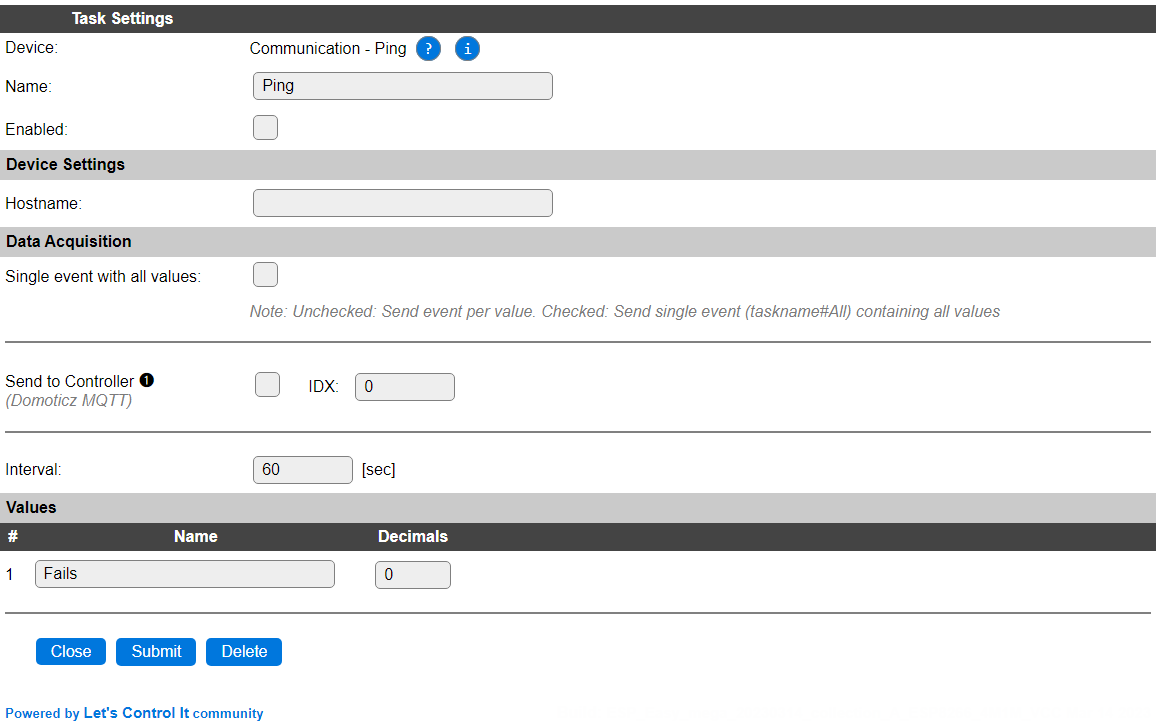
Name A unique name should be entered here.
Enabled The device can be disabled or enabled. When not enabled the device should not use any resources.
Device Settings
Hostname: The hostname or IP-address for the device or host to monitor.
ESP32 only:
Ping count: The number of pings that should be tried before reporting a failure. (Only available on ESP32 builds)
Available Values: The default is to only have a Fails value available, but for ESP32 there is also the Average ping-time in msec. available.

When changing this setting, the page will save and reload to adjust for the change in Values, below.
Data Acquisition
This group of settings are standard available configuration items.
Single event with all values: When this setting is enabled, all available values will be sent in a single event
<TaskName>#All, with all values in order as arguments to the event.Show derived values: When checked, the Devices overview page, and the
/jsonendpoint (used for updating the Devices overview page) will include any Derived values as defined. See theTaskValueSetDerivedandTaskValueSetPresentationcommands.Event & Log derived values: When checked, the Derived values will be generated as Events, to be handled in Rules, and sent to logging devices like the Syslog server and/or SD-card logging.
(The derived values options are only available if String variables feature is included in the build.)
Send to Controller: Select the Controller(s) to send the Values to, either on a
TaskRuncommand applied to the task, or on an Interval time action.
Send to Controller is only visible when one or more Controllers are configured.
Depending on the controller capabilities, some configuration settings may be shown:

All configured Controllers are shown here, including the enabled or disabled state (multiple Controllers can be enabled, only a single MQTT Controller can be enabled at one time!).
For each controller the user can select wether the data should be sent on each Interval (or explicit TaskRun).
For the Domoticz controllers the value index (IDX) has to be configured.
For some controllers, like Home Assistant/openHAB, there are extra options available.
Group: This represents the group id to combine all values from multiple tasks into a single grouped-device during MQTT AutoDiscovery. Groups, by design, can span multiple ESPEasy devices, if desired, as long as the Task/Valuename combinations are unique. If a group should only combine Tasks from a single ESPEasy unit, the group id should be unique across multiple ESPEasy units. The group description, default Group <n>, can be adjusted in Home Assistant. If the Group value matches the current Unit nr, the Unit name,
%sysname%, is used instead of Group <nr>.Retained: For MQTT Controllers, this setting can be enabled to send the values for the current task with the Retain flag set. The Publish Retain flag in the Controller settings will override this by sending all task values with Retain flag enabled.
Send derived: This checkbox determines if any configured Derived values should also be sent to the controller (and included in the AutoDiscovery if that’s available and enabled).
Resend MQTT Discovery: When checked, will start a resend of the MQTT Discovery process for this task after a random delay, when Submit is clicked, so any changed settings will be updated in the MQTT broker. This setting is only available if the controller is enabled, the Auto Discovery feature is available and enabled for the controller. This setting is not stored.
Other controllers, like f.e. FHEM HTTP, do not support additional settings besides the checkbox to enable sending the data.
Interval By default, Interval will be set to 60 sec. Every Interval setting, the host will be pinged and the state will be updated in Fails. If the ping responds as intended, then Fails is reset to 0.
Values
The failure count value is available in Fails. On ESP32 there is an option to also show the average ping-time in msec. via Avg_ms.
On ESP32, per Value is a Stats checkbox available, that when checked, gathers the data and presents recent data in a graph, as described here: Task Value Statistics:
Commands available
Command |
Extra information |
|---|---|
Examples:
Preferred syntax:
|
Set the Fails counter for the task. The deprecated syntax was instated before the generic task-specific command addressing, using |
Change log
Changed in version 2.0: …
added 2025-08-26 Enable support for ESP32
changed 2023-03-14 Extended command handling to not require the taskname argument.
added 2020-02-22