Environment - TMP117 Temperature
TMP117 Precision temperature sensor
Plugin details
Type: Environment
Name: TMP117 Temperature
Status ESP32: COLLECTION F CLIMATE
Status ESP8266: COLLECTION F CLIMATE
GitHub: P150_TMP117.ino
Maintainer: tonhuisman
Used libraries: .
Description
The Texas Instruments TMP117 High-accuracy temperature sensor offers an accuracy of 0.1°C in the range of -20°C to 50°C, and requires very low power when in shutdown mode.
The low/high alarm options and accompanying INT pin, as provided by the sensor, are not implemented in this plugin.
The datasheet offers the most up to date information: Texas Instruments TMP117 Datasheet (online)
Hardware
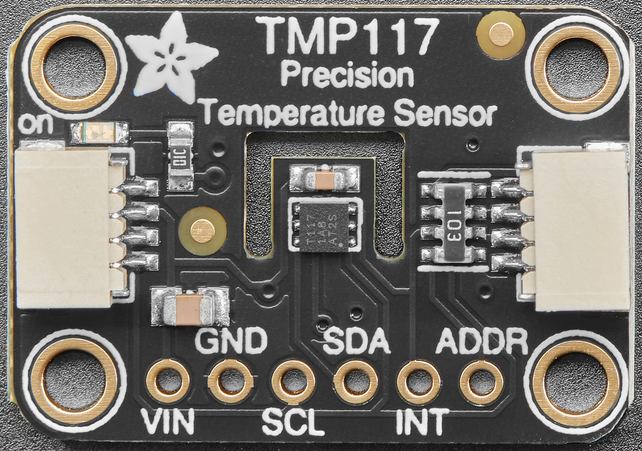
Adafruit TMP117 board.
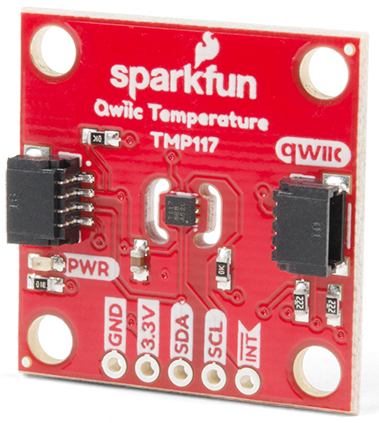
SparkFun TMP117 board.
Configuration
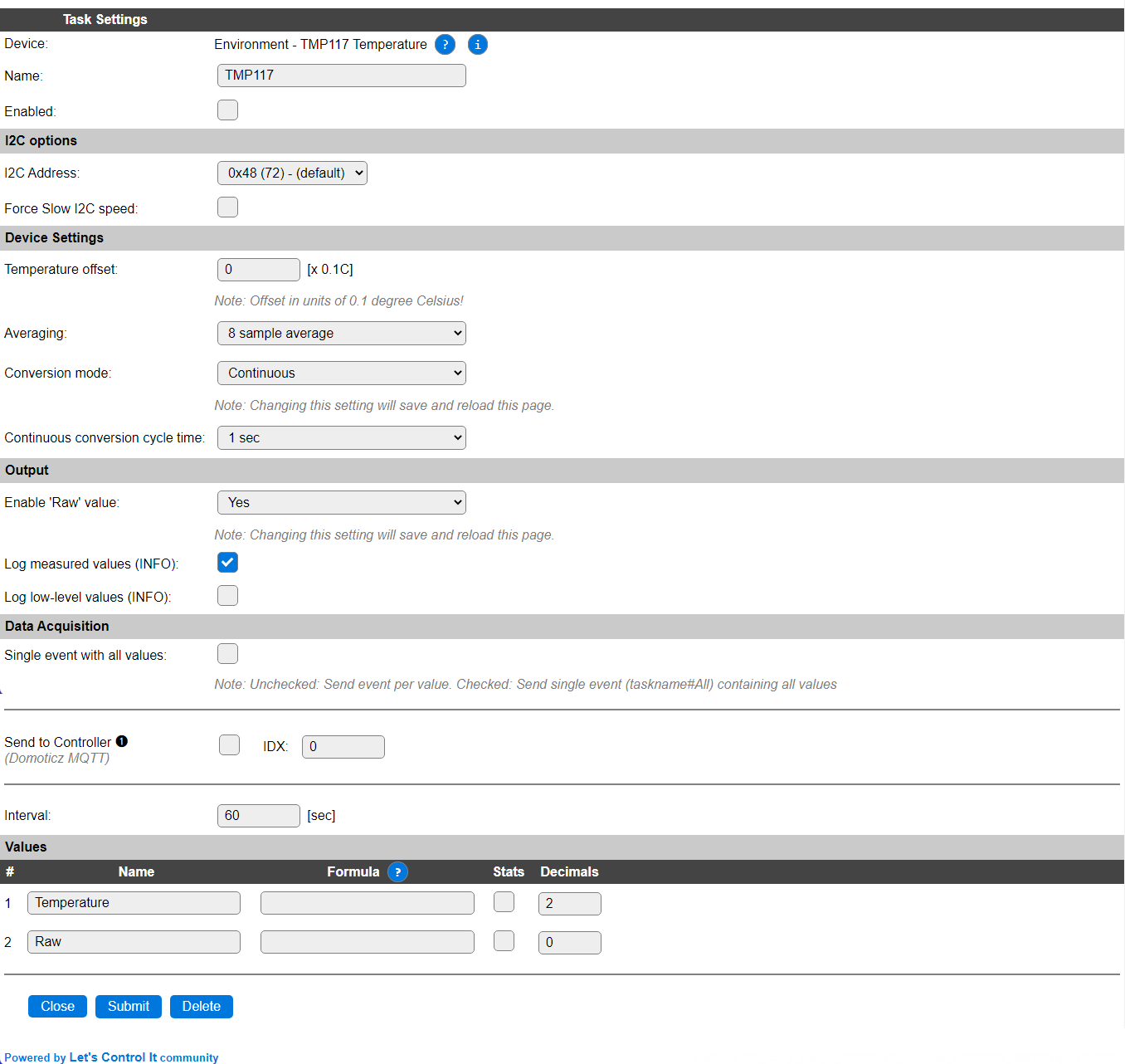
Name: Required by ESPEasy, must be unique among the list of available devices/tasks.
Enabled: The device can be disabled or enabled. When not enabled the device should not use any resources.
I2C options
I2C Address: The device supports up to 4 addresses, that can be configured using the
ADDRpin: (not all boards have the ADDR pin directly available, but use soldering-pads to configure the address)
Address |
ADDR pin to: |
Remark |
|---|---|---|
0x48 |
GND |
Default, also when not connected. |
0x49 |
VCC / VIN |
|
0x4A |
SDA |
|
0x4B |
SCL |
The available I2C settings here depend on the build used. At least the Force Slow I2C speed option is available, but selections for the I2C Multiplexer can also be shown. For details see the I2C Bus page
Device Settings
Temperature offset: An offset from the current temperature can be applied in 0.1°C steps. The number of steps can be set here.
Averaging: The sensor supports several averaging options, to stabilize the measurement. By default the average of 8 measurements is used.

No averaging: This turns off averaging.
8 sample averaging: Average the last 8 measured samples (default).
32 sample averaging: Average the last 32 measured samples.
64 sample averaging: Average the last 64 measured samples.
Conversion mode: The default measuring conversion mode is to continuously perform measurements.

Continuous: Continuously perform measurements, with a configurable cycle-time (see below).
One-shot: Perform a single measurement, then go into shutdown mode to conserve power. When the values are retrieved by the Interval event cycle, the One-shot mode is started, and read as soon as available (once per second). This value is returned on the next Interval, and a new One-shot measurement is started.
Warning
When changing this setting, the current settings are saved, and the page is reloaded, to show or hide the Continuous conversion cycle time setting, as that is only available/applicable for Continuous mode.
Continuous conversion cycle time: The delay between actual measurements in Continuous conversion mode. When this is set to a value longer than the Interval time, some of the Interval readings will return the previous values, as no new value has been read yet. It is advised to set the Interval higher than the configured cycle time.
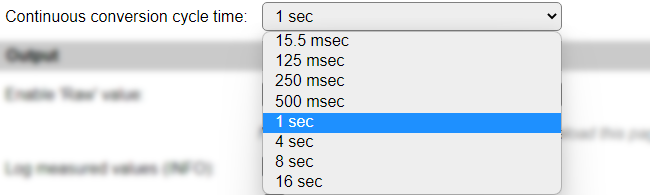
15.5 msec: A new measurement is performed every 15.5 milliseconds.
125 msec: A new measurement is performed every 125 milliseconds.
250 msec: A new measurement is performed every 250 milliseconds.
500 msec: A new measurement is performed every 500 milliseconds.
1 sec: A new measurement is performed every second.
4 sec: A new measurement is performed every 4 seconds.
8 sec: A new measurement is performed every 8 seconds.
16 sec: A new measurement is performed every 16 seconds.
This option is only available if Conversion mode is set to Continuous.
Output
Enable ‘Raw’ value: Select Yes if you want to include the Raw value on the Devices overview page, and when sent to controllers. This contains the raw digital value read from the sensor.
Warning
When changing this setting, the current settings are saved, and the page is reloaded, to show or hide the Raw Value (bottom of the page).
Log measured values (INFO): When checked, the values will be included in the serial log, when that is enabled, on INFO level.
Log low-level values (INFO): When checked, the values during the actual read (max. 1 per second) will be output to the serial log, on INFO level. This can be used for debugging purposes. May not be available in all builds to save space in the bin file.
Data Acquisition
This group of settings are standard available configuration items.
Single event with all values: When this setting is enabled, all available values will be sent in a single event
<TaskName>#All, with all values in order as arguments to the event.Show derived values: When checked, the Devices overview page, and the
/jsonendpoint (used for updating the Devices overview page) will include any Derived values as defined. See theTaskValueSetDerivedandTaskValueSetPresentationcommands.Event & Log derived values: When checked, the Derived values will be generated as Events, to be handled in Rules, and sent to logging devices like the Syslog server and/or SD-card logging.
(The derived values options are only available if String variables feature is included in the build.)
Send to Controller: Select the Controller(s) to send the Values to, either on a
TaskRuncommand applied to the task, or on an Interval time action.
Send to Controller is only visible when one or more Controllers are configured.
Depending on the controller capabilities, some configuration settings may be shown:

All configured Controllers are shown here, including the enabled or disabled state (multiple Controllers can be enabled, only a single MQTT Controller can be enabled at one time!).
For each controller the user can select wether the data should be sent on each Interval (or explicit TaskRun).
For the Domoticz controllers the value index (IDX) has to be configured.
For some controllers, like Home Assistant/openHAB, there are extra options available.
Group: This represents the group id to combine all values from multiple tasks into a single grouped-device during MQTT AutoDiscovery. Groups, by design, can span multiple ESPEasy devices, if desired, as long as the Task/Valuename combinations are unique. If a group should only combine Tasks from a single ESPEasy unit, the group id should be unique across multiple ESPEasy units. The group description, default Group <n>, can be adjusted in Home Assistant. If the Group value matches the current Unit nr, the Unit name,
%sysname%, is used instead of Group <nr>.Retained: For MQTT Controllers, this setting can be enabled to send the values for the current task with the Retain flag set. The Publish Retain flag in the Controller settings will override this by sending all task values with Retain flag enabled.
Send derived: This checkbox determines if any configured Derived values should also be sent to the controller (and included in the AutoDiscovery if that’s available and enabled).
Resend MQTT Discovery: When checked, will start a resend of the MQTT Discovery process for this task after a random delay, when Submit is clicked, so any changed settings will be updated in the MQTT broker. This setting is only available if the controller is enabled, the Auto Discovery feature is available and enabled for the controller. This setting is not stored.
Other controllers, like f.e. FHEM HTTP, do not support additional settings besides the checkbox to enable sending the data.
Interval By default, Interval will be set to 60 sec. The data will be collected and optionally sent to any configured controllers using this interval. If the Interval is set lower than the Continuous conversion cycle time, the interval will return the previously measured value until an actual measurement has been retrieved from the sensor.
Values
The plugin provides the Temperature and Raw values. Raw can be disabled, see above. A formula can be set to recalculate. The number of decimals can be set as desired, and defaults to 2 for Temperature, and 0 for Raw.
Per Value is a Stats checkbox available, that when checked, gathers the data and presents recent data in a graph, as described here: Task Value Statistics:
Change log
Changed in version 2.0: …
added 2023-04-15 Initial release version.